A spatially hybrid hydrological modeling approach using subbasin-specific model structures
Yu-Jing Wang, Liang-Jun Zhu*, Cheng-Zhi Qin, A-Xing Zhu
中文版
Overview
The spatial heterogeneity of watershed processes makes model structure adaptability
a key challenge in watershed process simulation.
Existing watershed modeling frameworks can account for heterogeneity by assigning different conceptual model structures
to different spatial areas.
However, they still offer limited support for the flexible integration of distributed and physically based model structures.
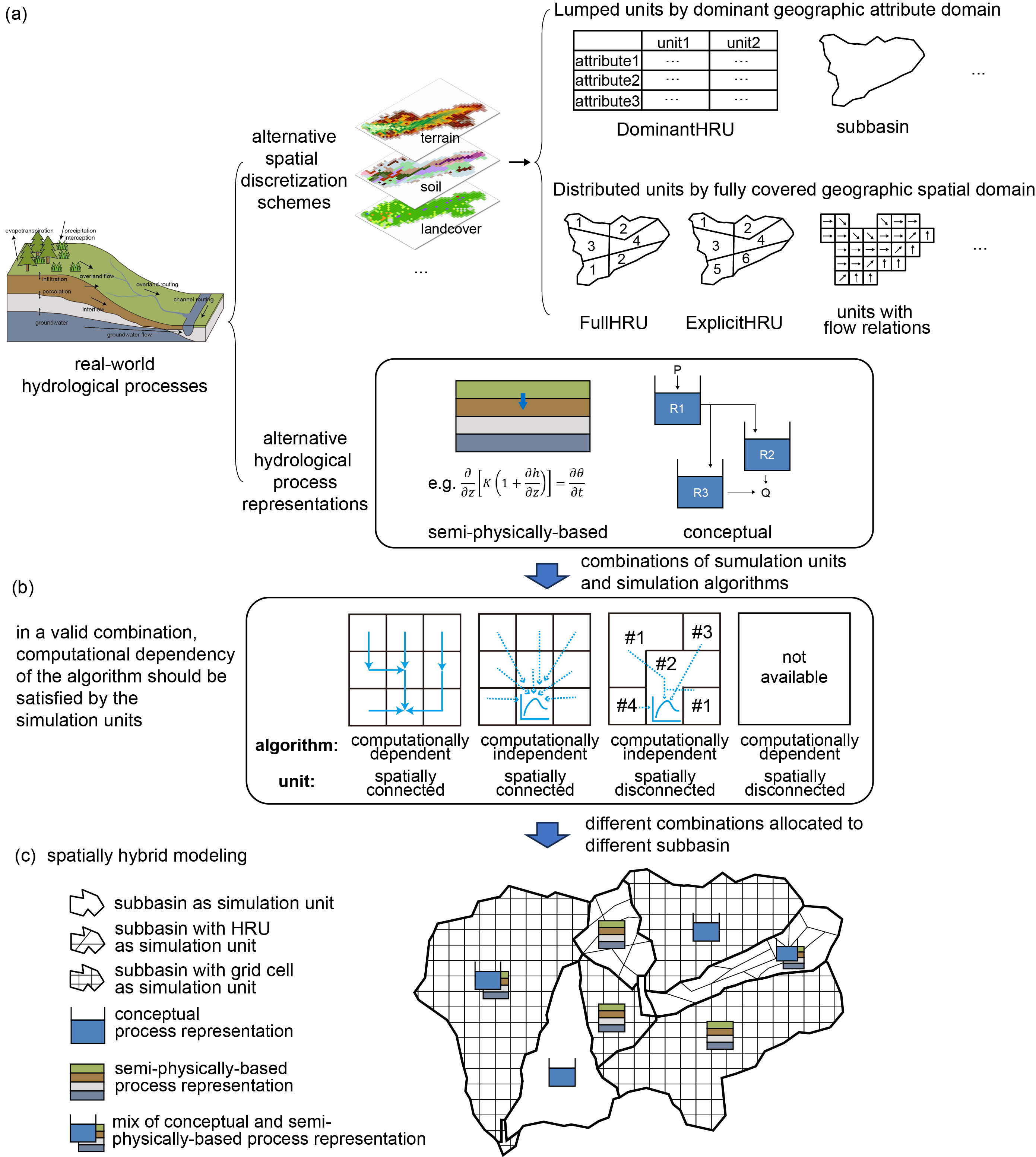
To address this gap, we propose a subbasin-specific spatially hybrid hydrological modeling approach.
Built on a divide-and-conquer idea, the approach allows flexible combinations of different spatial simulation units,
such as subbasins, HRUs, grids, or fields,
with different process representation algorithms, such as statistical, conceptual, or semi-physical methods,
to construct subbasin-level model structures.
These subbasin models are then integrated into a complete watershed model through channel routing.
Built upon the modular and parallelized SEIMS framework,
this study provides a proof-of-concept for the proposed approach and
discusses several directions for future development.
Review history
First submission to Journal of Hydrology: 2023-11-01; Manuscript-Submission1
Editor assigned: 2023-11-02 (updated on 11-09)
Reviewer(s) invited: 2023-11-16 (11-28, 12-01, 12-17, 12-20, 12-28, 01-13, 01-17, 01-26, toally 9 times!)
Reviews completed: 2024-01-31
Reject with invitation to resubmit: 2024-02-14; Decision Letter
Second submission to Journal of Hydrology: 2024-10-15; Manuscript-Submission2, Manuscript-with-tracks, Revisions and responses
Editor assigned: 2024-10-15 (updated on 10-25)
Reviewer(s) invited: 2024-10-26 (11-10, 11-19, 11-29, 12-24, 2025-01-01, totally 6 times)
Reviews completed: 2025-01-22
Reject with invitation to resubmit: 2025-02-14; Decision Letter
Third submission to Journal of Hydrology: 2025-06-19; Manuscript-with-tracks, Revisions and responses
Editor assigned: 2025-06-22
Reviewer(s) invited: 2025-06-23 (06-28, 07-08, 07-15, totally 4 times)
Reviews completed: 2025-08-12
Major revision: 2025-08-13; Decision Letter
Resubmit after major revision: 2025-08-26; Manuscript-with-tracks, Revisions and responses
Editor assigned: 2025-08-27
Reviewer(s) invited: 2025-08-30 (09-01, 09-05, totally 3 times)
Under review: 2025-09-04
Reject: 2025-09-14; Decision Letter
Submission to Environmental Modelling & Software: 2025-09-25; Manuscript-Submission
Editor assigned: 2025-09-28
Reviewer(s) invited: 2025-10-19 (10-29, 12-08, totally 3 times)
Reviews completed: 2025-12-08
Major revision: 2025-12-09; Decision Letter
Resubmit after major revision: 2025-12-30; Manuscript-with-tracks, Revisions and responses
Editor assigned: 2025-12-31
Reviewer(s) invited: 2026-01-05
Reviews completed: 2026-02-22
Accept: 2026-03-04; Decision Letter
Reflections: This paper marks the opening chapter of Dr. Yujing Wang’s doctoral dissertation.
From its first submission on November 1, 2023, to its final acceptance, the process took 2 years and 3 months,
making it the most difficult and tortuous paper I have experienced so far.
Judging from the number of reviewer invitations, in this era of explosive growth in publications,
very few people are willing to spend time reviewing manuscripts, and even fewer are willing to review revised versions
continuously. As a result, each round of revision tended to bring in new reviewers, which greatly increased the
difficulty of getting the paper accepted.
This manuscript was repeatedly held back at JoH because its hydrological theoretical contribution was considered insufficient.
Although we emphasized that the study provided a proof-of-concept for a modeling approach and also offered a modeling tool
for future exploration of hydrological theory, the handling editor did not accept this argument.
That was probably the direct reason why it was ultimately rejected there.
Still, through this process, we were able to think much more deeply about the significance of this work.
Citation
Wang, Y.J., Zhu, L.J., Qin, C.Z., and Zhu, A.X., 2026.
A spatially hybrid hydrological modeling approach using subbasin-specific model structures.
Environmental Modelling & Software, 200: 106944.
doi:10.1016/j.envsoft.2026.106944
« Back
|